
Global trends, macroeconomic data, and the outcome of the US Fed policy meeting are the major factors that will drive the movement in the domestic equity markets this week, analysts said. "In the upcoming data-centric week, the focus will be on crucial releases, including inflation data from India and the US. "Indian inflation is expected to rise, while US inflation will remain steady.

The Economic Survey said that a number of indicators -- GDP, IIP, credit, investment and capacity utilisation, point to a deceleration in real activity since first quarter of 2016-17 and a further deceleration since the third quarter.

India will drive growth in the Asia-Pacific (Apac) region as the growth engine is likely to shift from China to South and Southeast Asia in the coming years, S&P Global Ratings said in a report on Tuesday. The rating agency's report projected China's growth to slow down to 4.6 per cent by 2026 from an estimated 5.4 per cent in 2023. India is likely to clock 7 per cent economic growth from 6.4 per cent estimated for 2023.

S&P upgraded India's credit outlook to 'stable' from 'negative' earlier.

The BJP state unit hailed Vasan and said his advice will be used in the coming days to guide the alliance.

The most pressing issue facing the financial sector is the rising stock of non-performing assets in the banking system

'While every year presents new challenges, it also provides opportunities for better growth and performance.'

Automobile retail sales in India rose to a record high in November, aided by the best ever monthly performance across passenger vehicle and two-wheeler segments, dealers' body FADA said on Wednesday. The overall retail sales stood at 28,54,242 units last month, 18 per cent higher over 24,09,535 units in November 2022. Passenger vehicle (PV) retail sales rose to 3,60,431 units as compared to 3,07,550 units in the year-ago period, registering a growth of 17 per cent.

The sharp correction in the Indian markets from their peak levels has made valuations attractive, say analysts, who advise buying selectively, but only from a long-term perspective. Fifty-six of the Nifty 100 stocks, according to Mahesh Nandurkar, managing director at Jefferies, now trade below the 10-year historical averages, including stocks in financial, select auto, and pharma sectors. "Valuation (one-year forward consensus price-to-earnings, PE) has declined 25 per cent from October 2021 peak, almost matching the 33 per cent price-earnings contraction during the 2011 tightening cycle when repo rates went up by 375 basis points (bps) versus 250 bps this cycle.

Reflecting subdued global economic growth, India's outward foreign direct investment (FDI) fell by 33.3 per cent sequentially to $1.21 billion in August, compared to over $1.82 billion in July.

It has mostly been a one-way street for smallcap stocks that have taken it on their chin thus far in February. The Nifty Smallcap 250 index has shed 3.2 per cent in the current month as compared to the 1.8 per cent decline in the Nifty Midcap 100 and the 0.5 per cent drop in the Nifty 50 index, data showed. Technically, the index has slipped below its 20-day moving average (DMA) placed at 14,800 levels on Monday, and is currently testing the 50-DMA, and is placed at 14,278 levels.

The weak April-June quarter (first quarter, or Q1) results of the largest listed specialty chemical maker, SRF, and multiple global headwinds for the sector are expected to weigh on the prospects of Indian specialty chemical companies in 2023-24 (FY24). Stocks in the sector (down 7-18 per cent) have underperformed the benchmarks (up over 10 per cent) in the past three months, and given the multiple challenges, the trend is likely to continue. Kotak Institutional Equities expects a very weak quarter (Q1FY24) for the sector due to destocking, demand weakness across certain critical end-use industries, and price erosion amid intense competition from Chinese suppliers.

These core industries comprise 40.27 per cent of the weight of items included in the Index of Industrial Production.

'Although mid- and small-cap funds have the potential for higher growth, they come with inherent higher volatility.'

Among the Sensex firms, Larsen & Toubro, UltraTech Cement, JSW Steel, Titan, Bajaj Finance, Wipro, Tech Mahindra and Nestle were the major laggards. Maruti, Power Grid, Axis Bank, State Bank of India, NTPC, HDFC Bank, ITC and IndusInd Bank were the gainers.

The gauge for the performance of informational technology (IT) stocks soared nearly 5 per cent-most in nearly three years-as growth worries eased following a robust order book posted by bellwether Tata Consultancy Services (TCS). The Nifty IT index rose 4.5 per cent to close at 30,945. This was the biggest single-day gain since September 14, 2020. Industry titan TCS' shares rose 5 per cent to Rs 3,509.

Hiring prospects in the hospitality sector look bright as a large number of employers are expected to increase their workforce considerably in the coming months, global staffing services firm Manpower says.
Amid cooling raw material prices, the crude-oil linked companies, which includes paint and tyre firms, have been on a roll over the past one year. Shares of related companies have gained up to 84 per cent, as against a 14 per cent rise in the S&P BSE Sensex. Analysts, however, believe stretched valuations in both these sectors could trigger a de-rating.

A likely turnaround in profitability margins in the March quarter (Q4FY23) will not be enough to lift the outlook for paint stocks due to volatile crude oil prices and rising competition in the sector, analysts say. Hence, they advise investors to avoid the sector over the short-to-medium term despite the heavy correction in the stocks since last year. Shares of Asian Paints, Berger Paints, Indigo Paints, Nerolac and Pidilite have shed 6-32 per cent over the last 6 months versus a 3 per cent rise in the benchmark Sensex.

Polarisation in the performance of Indian banks will persist as many large public sector banks are still saddled with weak assets, high credit costs, and poor earnings, S&P Global Ratings said on Thursday. It said State Bank of India and leading private sector banks have largely addressed their asset quality challenges, and their profitability is improving more sharply than the banking system. In its Global Banking Outlook-2023 report, S&P said economic recovery is driving credit costs to cyclical low levels and stronger balance sheets and higher demand should boost bank loan growth, but deposit growth will lag.

Since their highs in September, chemical stocks have underperformed the benchmarks and broader indices over the past month with larger players witnessing a 9-22 per cent fall during this period. Expectations of weak September quarter results amid high inventory, demand woes and weak realisations have led to the underperformance.

The sharp rally in the markets thus far in fiscal 2023-24 (FY24) has left analysts struggling to find investment-worthy themes. The S&P BSE Sensex has surged nearly 7 per cent thus far in FY24 and hit a fresh 52-week high of 63,601.71 levels on June 22, mostly led by foreign institutional (FII) flows. "The Indian market has seen a broad rally in the past few months but headline indices have seen more modest performance. "We are not very clear about the reasons for the rally and the divergent performance and struggle to find ideas in the consumption, investment and outsourcing sectors after the sharp run-up in several of our favored sectors and stocks in the past two months," wrote Sanjeev Prasad, co-head, Kotak Institutional Equities, in a recent co-authored note with Anindya Bhowmik and Sunita Baldawa.

Double-digits salary hikes are making a post-pandemic comeback on the back of a buoyant business outlook in 2023, according to global professional services firm Aon. Aon's latest "Salary Increase Survey in India" has not only projected a 10.4 per cent average hike across sectors for 2023, but also identified actual hikes in 2022 at 10.6 per cent as against its previous projection of 9.9 per cent in February. The figure of 10.6 per cent is the highest since 2012, whereas the 10.4 per cent levels projected for 2023 were last seen in 2015.

The report suggests that one of the major impacts of COVID-19 on the media and entertainment industry is the instability caused and the downfall in the advertising revenues across all media segments

'Earnings will be the catalyst for markets to march higher from here on out.'

There are no major announcements in the Union Budget 2014-15.

India, along with Southeast Asian countries such as Indonesia, is expected to sustain growth in the medium-term in Asia region, replacing China as the key growth driver, Morgan Stanley and Nomura said in two separate reports released on Monday. While Morgan Stanley projected a 6.2 per cent gross domestic product (GDP) growth forecast for India in FY24, Nomura estimated the Indian economy to grow at 5.9 per cent in 2023. "Even with a slowing China, we expect GDP growth in Asia to sustainably outperform other emerging markets and the US. India and Southeast Asia are set to be the fastest-growing economies this decade.

India's largest asset manager SBI Funds Management on Tuesday said they are negative on equities from a shorter-term perspective as valuations have risen above the comfort zone. "We are not positive on equities. We think valuations are expensive. "The market has gone up a lot more than the earnings have grown," said R Srinivasan, Chief Investment Officer (CIO) - Equity at SBI Mutual Fund, at the launch of asset management companies' (AMC) yearly report on the market outlook.

After being underweight on domestic agrochemical companies and preferring global plays, brokerages believe that the former may perform better in the quarters ahead. Domestic crop protection companies have faced multiple headwinds over the past year and a half, given high inventory costs, pricing pressures, lower realisations in the generic segment, increased stocks due to lower infestations, and demand-led hits to volumes. Some of the overhang from previous quarters was reflected in the April-June quarter (first quarter, or Q1) of 2023-24 (FY24) as well, with aggregate revenues and operating profit for the sector down 12 per cent and 27 per cent, respectively.

The general elections in April/May 2024 are expected to add volatility to the Indian markets, keeping investors on their toes.

Draft Red Herring Prospectus (DRHP) filing continued to be robust in October, signifying the optimism in the initial public offer (IPO) market despite the recent turbulence in equities. In October, 17 companies filed their offer documents for IPOs. The rush in filings has made August-October 2023 the best three-month period for DRHP filings since July-September 2021.

India Inc's net profit as a percentage of the country's gross domestic product (GDP) is just shy of reaching 5 per cent, bolstered by strong earnings growth in the second quarter of 2023-24. Analysts interpret this as an indication that a corporate profit upcycle is in progress, with projections suggesting that this share could exceed 8 per cent within the next five years, driven by bullish earnings growth expectations. "We believe we are only halfway through a profit cycle, with the profit share in GDP rising from a low of 2 per cent in 2020 to about 5 per cent currently, and likely heading to 8 per cent in the coming four to five years. "This implies about 20 per cent compounding of earnings growth. "Underscoring this forecast is the start of a new private capex cycle, under-geared balance sheets, a healthy banking system, lower corporate tax rates, improving terms of trade, and structural consumption demand outlook albeit somewhat offset by likely consolidation in government deficit," said Ridham Desai, managing director, head of research, Morgan Stanley India in a note.

An index value of 42 to 46 means moderate decline.

The Centre could better its fiscal deficit at 6.6 per cent of GDP in this financial year on stronger-than-expected revenue buoyancy, even if the budgeted disinvestment target is not met, Fitch Ratings has said. The international rating agency had last week kept the sovereign rating unchanged at 'BBB-' with a negative outlook, and said that the risks to India's medium-term growth outlook are narrowing with rapid economic recovery from the pandemic and easing financial sector pressures. In an email interview with PTI, Fitch Ratings Director (Asia-Pacific Sovereigns) Jeremy Zook said the two key positive triggers that could lead to a revision of the outlook to stable are implementation of a credible medium-term fiscal strategy to lower debt burden and higher medium-term investment and growth rates without the creation of macroeconomic imbalances, such as from successful structural reform implementation and a healthier financial sector.

'India has always been a bottom-up stock-picking market, and as growth recovers with higher liquidity, mid and small-caps always tend to outperform.'

India's electric two-wheeler (E2W) sector is expected to cross the one million mark in 2024 fuelled by rising demand, increased production, and affordability, industry experts said, even as several original equipment makers are expanding their penetration to rural areas. Improved battery technology and innovative features are also likely to fuel growth, they said. "E2W sales will breach the 1-million mark in 2024 as the demand for electric two-wheelers is expected to continue growing due to factors such as environmental awareness, government incentives, and improvements in technology," Hyder Khan, chief executive officer (CEO), Godawari Electric Motors, said.

'It will dictate the flow of funds into the index. We will maintain caution on mid/smallcaps.'

Business confidence remained positive in August and was driven by upbeat forecasts of sales, an expected improvement in demand and promotional activities

The six-member monetary policy committee voted 5:1 for the decision, with only Ravindra Dholakia voting for a 0.25 per cent reduction in rates.
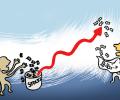
In a dazzling resurgence, foreign investors have graced the Indian equity markets with an influx of nearly Rs 1.5 lakh crore in 2023, fuelled by optimism over the country's resilient economic fundamentals amid shadows of a gloomy global scenario. Experts believe that the positive trend may continue in 2024. This follows Indian equities witnessing the worst-ever net outflow of Rs 1.21 lakh crore by FPIs in 2022 on aggressive rate hikes by the central banks globally after net inflows for three consecutive years.
